
3D-IC technology is gaining attention as an alternative to complement Moore’s Law, which is approaching its physical limits. Unlike traditional 2D IC design, 3D-IC requires a differentiated verification process. In particular, Electronic Design Automation (EDA) solutions have become essential tools to support this transition.
However, the unique characteristics of 3D-ICs introduce new challenges in the design and manufacturing process, particularly in verification. Traditional verification methodologies used for 2D designs are no longer sufficient. As a result, the need for advanced and specialized verification tools has become critical. In this context, Electronic Design Automation (EDA) solutions play an essential role in enabling accurate modeling, analysis, and validation of 3D-IC systems. Calibre 3DSTACK offers a comprehensive solution for verifying heterogeneous designs.
Challenges
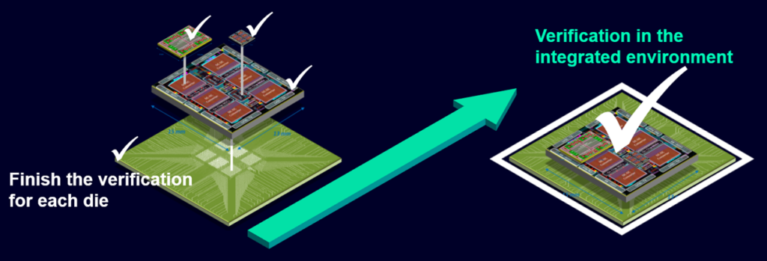
Efforts to overcome the limitations of 2D semiconductor design continue, but there are still challenges related to technology and cost. Issues that may arise during the stacking and placement of various dies are often difficult to predict. Even if DRC, LVS, and PEX verification has been completed for a 2D design, there is no guarantee that a 2.5D or 3D-IC will function correctly after assembly. Therefore, while different design processes progress independently, a comprehensive verification step is required once again to ensure reliability.
Solution
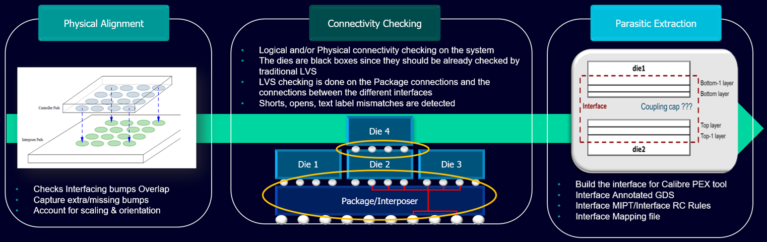
Calibre 3DSTACK offers a fast and precise solution for verifying complex 2.5D and 3D-IC designs. As multi-die systems introduce challenges like inter-die connectivity, misalignment, and TSV-related issues, early detection becomes critical. By enabling designers to identify and resolve potential errors before physical assembly, Calibre 3DSTACK helps reduce costly rework, improve design reliability, and ensure a smoother path to manufacturing.
(Source: Siemens)
Read more:
- Smarter, Faster AI Chip Design with Siemens’ 3D IC Packaging Technology at ETRI and Amkor
- How AI is accelerating semiconductor testing
- How AI will enable DevOps for hardware