
As IC and PCB designs become increasingly complex, demands for computing power, simulation, and verification continue to grow. Optimizing workflows and reducing processing time have therefore become important challenges in electronic product development.
Siemens EDA AI combines traditional EDA methods with Machine Learning (ML), Reinforcement Learning (RL), Generative AI, and Agentic AI to support a wide range of activities, from design implementation and simulation to Design-for-Test (DFT), physical verification, and workflow orchestration.
This approach is not intended to replace existing EDA tools or engineering expertise. Instead, AI helps process data, automate certain tasks, and suggest optimized approaches. Results must still be evaluated through appropriate engineering workflows, particularly during verification and sign-off.
1. Three Key Directions in Siemens EDA AI Development
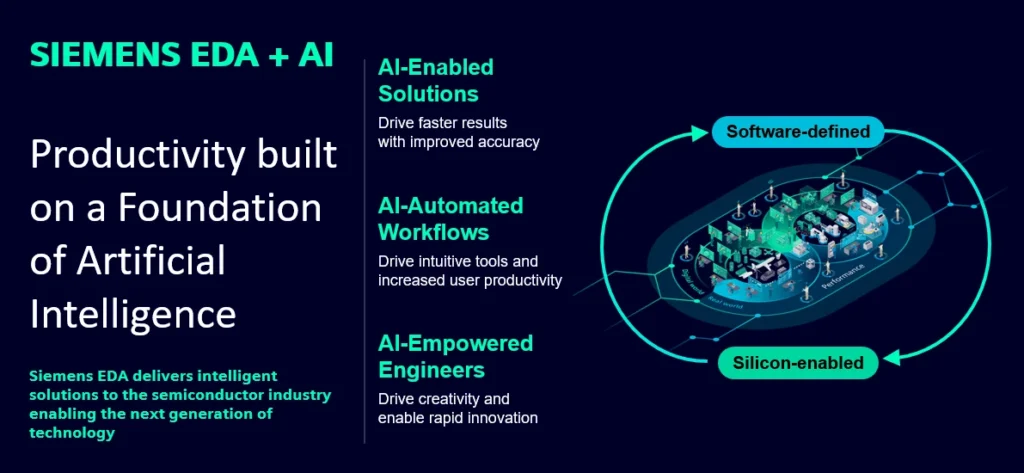
Siemens EDA develops AI applications around three main pillars:
- Faster Engines – AI combines with advanced computational methods to support design, simulation, verification, and optimization tasks.
- Smarter Execution – Generative AI and specialized AI agents help engineers perform repetitive tasks, interact with tools using natural language, and coordinate steps across engineering workflows.
- Trusted Outcomes – AI supports recommendations and task execution, while final results must still be evaluated using the appropriate EDA tools and verification processes.
These directions are reflected in several solutions across the Siemens EDA ecosystem, including Aprisa AI, Solido Generative & Agentic AI, Tessent Embedded AI, Calibre Vision AI, and Fuse EDA AI System.
2. Aprisa AI – PPA Optimization for Digital IC Design
In digital IC design, achieving targets for Power, Performance, and Area (PPA) often requires engineers to test multiple implementation approaches and continuously adjust parameters. This process can consume considerable time before a design meets its requirements.
Aprisa AI applies ML, Reinforcement Learning, Generative AI, and AI agents to support implementation from RTL to GDS. Its AI Design Explorer helps automatically explore implementation strategies based on PPA targets defined by engineers, supporting the search for suitable solutions and reducing manual tuning.
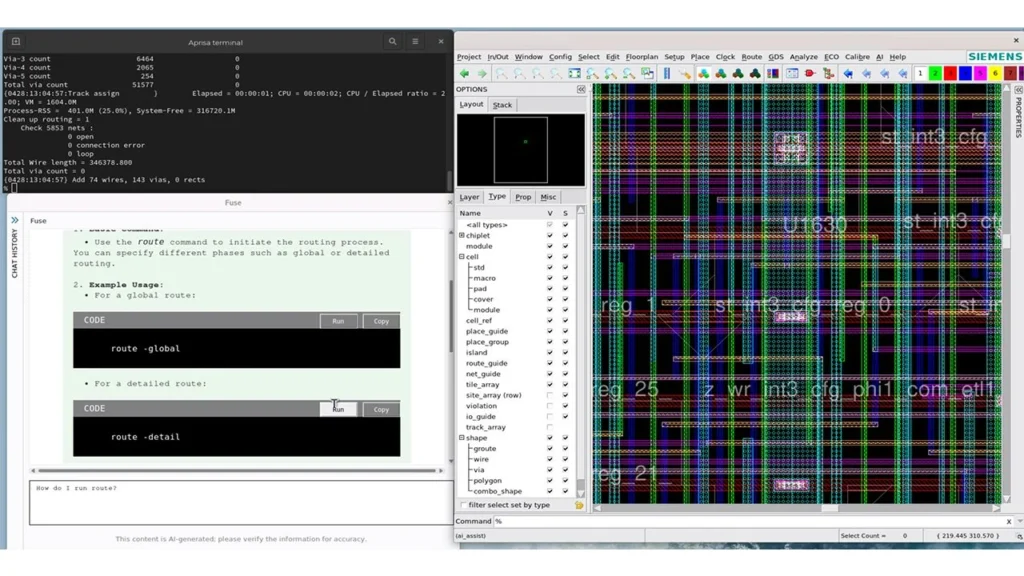
Beyond implementation optimization, Aprisa also supports natural-language interaction, command suggestions, and the automation of certain design tasks. Engineers retain control over execution and result evaluation.
3. Solido AI – AI for Custom IC and Analog/Mixed-Signal Design
Custom IC and analog/mixed-signal design typically involves multiple simulation iterations, waveform analysis, testbench checks, and evaluations of the effects of variation.
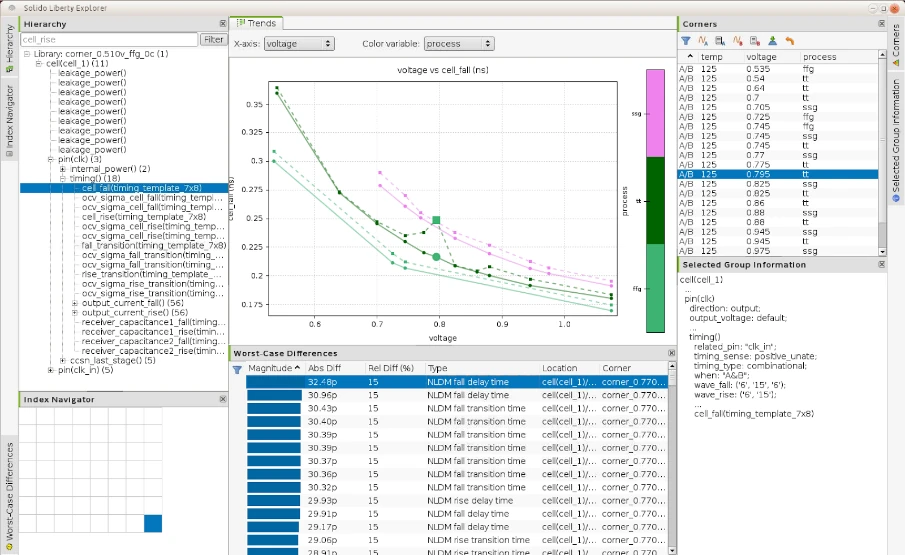
Solido Generative & Agentic AI supports various workflows, from simulation and variation-aware verification to library characterization and IP validation. AI capabilities can help predict computational resource requirements, optimize testbenches, summarize key metrics, and analyze logs or waveforms to help engineers identify issues requiring further investigation.
Rather than replacing simulation engines, AI adds capabilities for data analysis and interpretation, making technical results easier for engineers to review during design evaluation.
4. Tessent Embedded AI – Optimizing Testing and Supporting Yield Analysis
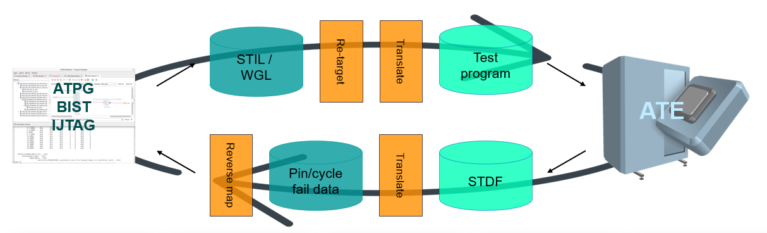
AI technologies within the Tessent ecosystem support activities related to Design-for-Test (DFT), testing, and failure data analysis. Analytical and predictive AI technologies can help optimize ATPG, evaluate fault coverage, perform diagnosis, and support yield learning. For example, ATPG Expert can help adjust test parameters to balance fault coverage against the number of test patterns required.
During post-production analysis, Machine Learning and probabilistic methods can help identify potential defect locations or causes, known as defect suspects. Factors that systematically affect yield can also be investigated by analyzing data from large numbers of chips.
5. Calibre Vision AI – Identifying and Analyzing DRC Violations
Complex IC designs can generate large numbers of violations during Design Rule Check (DRC). Reviewing each violation individually and identifying errors with common root causes can prolong the debugging process.
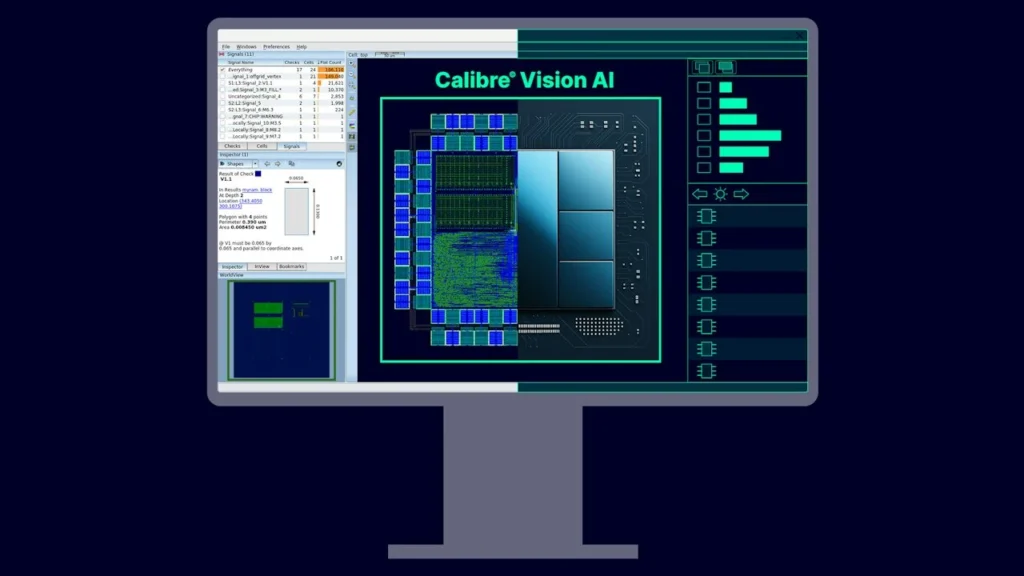
Calibre Vision AI helps engineers analyze DRC results by visualizing violation density across a chip, grouping violations with similar characteristics, and organizing results by chip, block, or hierarchy. This enables verification teams to identify areas with high concentrations of errors, locate hotspots, and prioritize groups of violations for further investigation.
However, it is important to distinguish Vision AI’s role from physical verification itself. The Calibre rule deck and physical verification engine remain the basis for determining whether a design complies with the applicable design rules. Vision AI supports analysis and debugging; it does not replace DRC execution or sign-off.
6. Fuse EDA AI System – Ultilizing AI Across the EDA Ecosystem
While solutions such as Aprisa, Solido, Tessent, and Calibre focus on specific engineering challenges, Fuse EDA AI System aims to support interaction and task coordination across a broader range of the EDA ecosystem.
Fuse combines EDA knowledge, authorized technical data, natural-language interfaces, and AI agents to support workflows across multiple tools. The system uses EDA-specific Retrieval-Augmented Generation (RAG) to retrieve product information, commands, and workflow guidance relevant to the engineering context.
The specific tasks Fuse can perform depend on supported functionality and the system’s deployment configuration. The roles of these solutions can be summarized as follows:
- Aprisa AI: Digital implementation and PPA optimization.
- Solido AI: Simulation, variation analysis, and Custom IC design.
- Tessent AI: DFT, ATPG, diagnosis, and yield analysis.
- Calibre Vision AI: Physical verification analysis and DRC debugging.
- Fuse EDA AI: Connecting knowledge, data, natural-language interaction, and AI agents across multiple workflows.
7. From Automation to Engineering Intelligence
AI in Siemens EDA extends beyond interacting with software through natural language. It is being incorporated into specific engineering workflows, from RTL-to-GDS optimization and simulation to testing, physical verification, and design data analysis.
When applied to the right challenges, these solutions can reduce repetitive tasks, shorten the time needed to find information, and help engineers process data more efficiently. This gives design teams more time to focus on critical engineering decisions.
However, implementation effectiveness depends on each business’s actual needs and workflows. Before selecting a solution, businesses should identify bottlenecks in their current processes, assess compatibility with existing systems, and consider deployment models, data security requirements, and licensing.
Learn more
- Workshop: Accelerating Semiconductor Chip Design with Siemens Calibre
- Vietbay attends the SemiExpo Vietnam 2026 Kick-Off Program
About us
Vietbay – Siemens’ official distribution partner in Vietnam –provides software solutions and digital engineering services, including consulting, implementation, and post-sales technical support. Businesses interested in Siemens EDA AI solutions, product configurations, or demonstrations can contact Vietbay for detailed consultation.