
From an impressive prototype to a humanoid robot platform ready for industrialization

Humanoid robotics is entering a new phase. Humanoid robots are moving beyond technology demonstrations toward practical applications in manufacturing, logistics and environments designed for people. This is part of the rise of Physical AI – artificial intelligence that can not only process information but also perceive, interact with and act in the physical world.
From “a robot that works” to “a robot ready for commercialization”
The challenge in humanoid robotics today goes beyond enabling a robot to walk, grasp objects or perform a task. The bigger question is how to continuously improve its design, shorten development time and bring it to production scale.
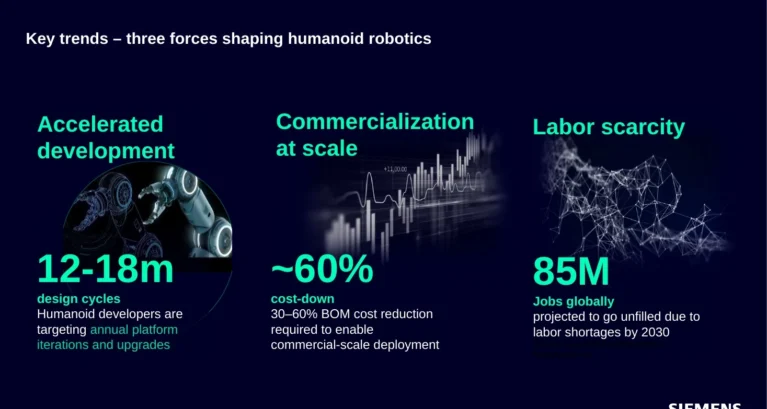
According to Siemens materials, many developers are targeting platform update cycles of approximately 12–18 months while significantly reducing bill of materials (BOM) costs to support commercial deployment. This makes design iteration speed, early validation and connected data increasingly important competitive factors.
Digital Twin: Reducing iteration before building hardware
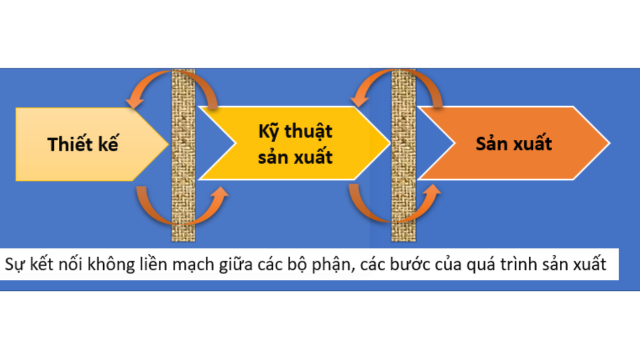
A humanoid robot is a complex combination of mechanical components, actuators, sensors, electrical systems, batteries, controls and robotics software. In a traditional workflow, teams often work with separate tools. Each change may require data export, model conversion, URDF updates, another round of simulation and further rework.
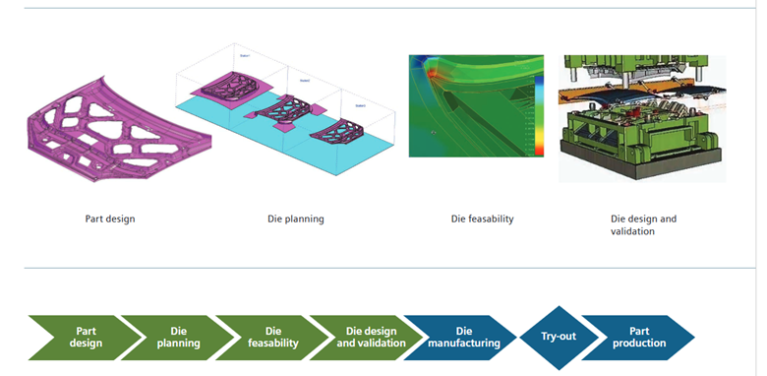
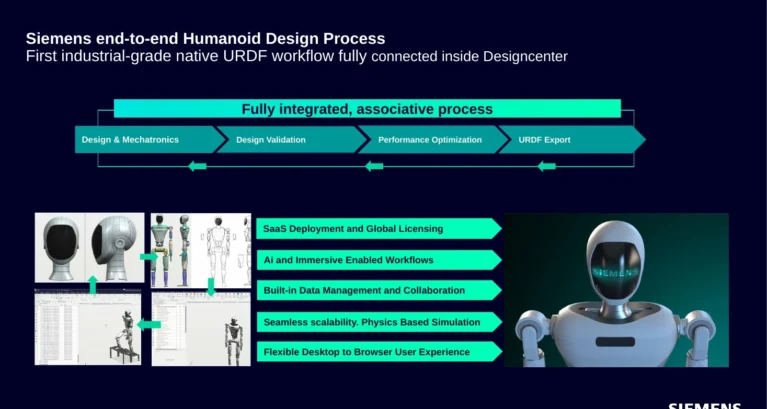
Siemens addresses this challenge through a connected Digital Thread, with the Digital Twin serving as a shared foundation for the Design – Validate – Optimize – Robotics process. Engineers can build the robot structure and evaluate motion, workspace, loads, center of mass, joint limits and collisions before investing in a physical prototype.
Connecting engineering and robotics more quickly
A key capability is transferring design data into robotics environments through URDF. Instead of repeatedly rebuilding the model after every CAD change, an integrated workflow helps preserve design intent and reduce manual steps between CAD and ROS. For robotics development teams, that means less time fixing data and more time optimizing the product.
“Prove the robot before you build it”
Simulation increasingly needs to begin early in development. The combination of Designcenter and Simcenter enables teams to evaluate motion, structural, thermal and multiphysics challenges using the same Digital Twin data. The goal is clear: identify problems in the digital model before they appear in an expensive prototype.
The next challenge is industrialization
As humanoid robotics moves from research labs into the real world, competitive advantage will come from more than AI or a robot’s ability to move. It will also depend on faster development, fewer iterations, connected mechanical – electrical – simulation – robotics workflows and the ability to scale from a few prototypes to a product platform that can be manufactured in volume.
From Prototype to Platform. From Fragmented to Integrated. From Trial-and-Error to First-Time-Right Engineering.
Through Siemens Xcelerator, together with Designcenter, Simcenter, Teamcenter and Capital, Siemens is building a connected engineering ecosystem to support that journey – from concept, Digital Twin and validation to a new generation of humanoid robots ready for the real world.
About Vietbay
Vietbay is an authorized partner of Siemens Digital Industries Software in Vietnam, providing consulting, implementation and technical support for Siemens solutions. With experience in design, simulation, Digital Twin and automation, Vietbay helps businesses select and apply solutions suited to their product development processes, including Designcenter, Simcenter, Teamcenter and solutions within the Siemens Xcelerator portfolio.
If your business is exploring humanoid robotics, robotics or Digital Twin workflows for product development, Vietbay can support you from solution consulting through implementation and technical training. Contact Vietbay to discuss your specific needs.