
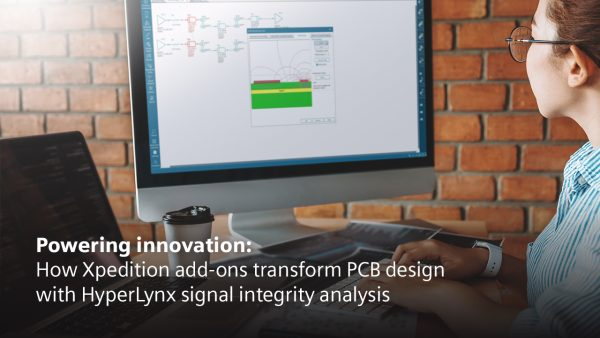
In today’s highly competitive electronics industry, time to market is a critical competitive factor. This pressure requires engineering teams and design engineers to continuously innovate while refining and optimizing their entire design workflow.
Forr PCB design engineers, meeting these demands means leveraging advanced software tools that deliver accuracy, flexibility, and fast processing. This is where the Siemens Xpedition ecosystem comes in, combining comprehensive PCB design capabilities with powerful add-on tools for Signal Integrity (SI) analysis powered by HyperLynx.
Xpedition offers add-on capabilities through a token-based licensing model. This enables businesses to integrate advanced simulation features seamlessly into both pre-layout and post-layout design stages. The combination helps reduce design iterations and enables engineering teams to achieve better results on the first pass.
This is particularly valuable for small and medium-sized engineering teams. They can now access advanced technologies previously associated with large enterprises without incurring substantial upfront investment or dealing with the complexity of deploying additional infrastructure.
1. Transforming PCB Design with Xpedition’s Token-Based Licensing
Have you ever wondered whether your company’s current investment in design tools is delivering its full value, or whether your engineering team is wasting budget on licenses and add-on features that remain unused?
Xpedition’s flexible token-based licensing model is changing how engineering teams access advanced design capabilities.
Think of it as a shared toolbox in a collaborative makerspace: engineers can check out specialized tools when needed and release them when their tasks are complete, without disrupting the workflow or wasting licensing resources.
The token system helps businesses optimize resources in three key ways:
- Activate capabilities when needed: Enable advanced features such as HyperLynx signal integrity analysis or rigid-flex PCB design tools according to specific project requirements.
- Scale capabilities seamlessly: Expand design functionality as projects evolve without replacing the core software or disrupting existing workflows.
- Share resources across the team: Allow engineers to draw from a shared token pool, reducing licensing costs and making advanced tools accessible to more team members.
See how Xpedition’s token-based licensing works in practice:
With a shared token pool, businesses can allocate advanced software capabilities for the periods when projects actually require them. For example, once an SI simulation task is complete, the tokens can be returned to the shared pool for other engineers to use.
This flexibility helps maximize the value of software licensing investments while supporting both engineering innovation and operating cost optimization.
2. Understanding HyperLynx-Powered Signal Integrity Add-ons
2.1. What Is Signal Integrity (SI)?
Signal Integrity (SI) refers to the quality and reliability of electrical signals as they travel through PCB traces and interconnects.
As data transmission speeds increase, signal integrity issues become more likely. Common problems include signal ringing, noise, crosstalk, and jitter. If left undetected, these issues can cause intermittent circuit behavior or system failure, potentially forcing manufacturers to redesign and rebuild circuit boards at significant cost.
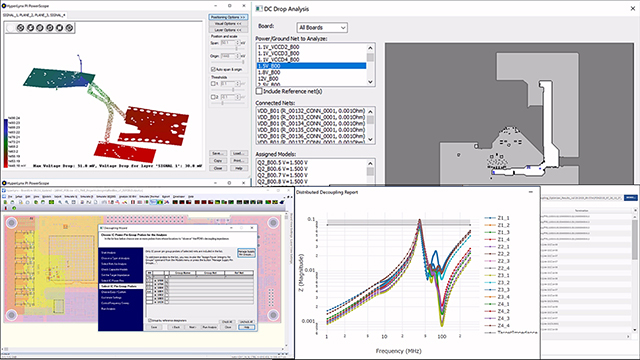
By integrating HyperLynx directly into the Xpedition design environment, engineers can identify and address SI issues from the earliest stages of development. Verifying signal performance before manufacturing helps teams:
- Minimize costly design rework.
- Keep projects on schedule amid time-to-market pressures.
- Handle dense component layouts and complex PCB stack-up structures more effectively.
2.2. Pre-Layout Simulation with HyperLynx: Get the Design Right from the Start
Before beginning complex routing or making final design decisions, HyperLynx-powered pre-layout simulation helps establish a solid foundation for the project.
Running simulations early allows engineers to identify and mitigate potential SI risks before they develop into more serious problems that are difficult and expensive to correct later.
Key capabilities include:
- Accurate setup with model libraries: Assign realistic component models and IBIS models to help ensure simulation results reflect actual electrical behavior as closely as possible.
- Intuitive stack-up editor: Review and adjust PCB stack-up parameters, such as dielectric constants, to achieve target impedance for single-ended traces and differential pairs.
- Interactive design guidance: Use tools such as the Terminator Wizard to calculate and optimize trace lengths and appropriate termination resistor values.
- Field visualization and sweep analysis: Run simulations to evaluate electromagnetic coupling between traces and analyze critical impedance parameters.
Pre-layout simulation enables engineering teams to make informed design decisions early, reducing downstream risks by identifying potential problems before detailed routing begins.
See pre-layout simulation in action:
2.3. Post-Layout Simulation with HyperLynx: Verify Performance Before Prototyping
Once the PCB layout is complete, post-layout simulation helps engineers verify how signals will behave under realistic operating conditions. This makes it possible to identify potential signal integrity issues before prototype fabrication, avoiding costly hardware revisions.
Key capabilities include:
- Seamless integration: Launch HyperLynx directly from the Xpedition layout interface for in-depth analysis without manually exporting and importing design files.
- Virtual oscilloscope: Visualize signal behavior across the board and inspect issues such as ringing and timing delays.
- Comprehensive analysis tools: Run batch simulations to evaluate crosstalk, signal quality, and electromagnetic compatibility (EMC).
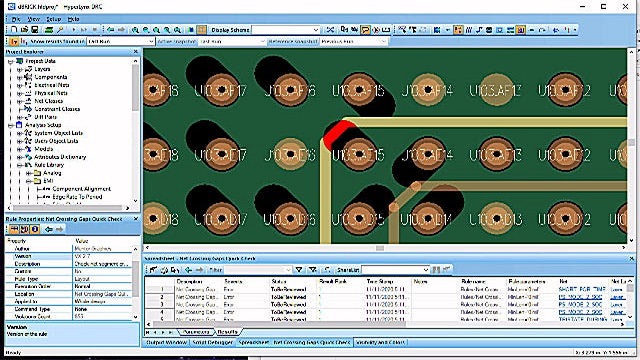
- Detailed reporting: Generate visual HTML reports with color-coded pass/fail results and detailed error analysis, helping engineers quickly identify problem areas.
Post-layout simulation helps engineers verify signal performance before manufacturing, identify potential issues before building hardware, shorten prototype cycles, reduce development costs, and manage design risks proactively.
See post-layout simulation in action:
3. A Comprehensive Solution for PCB Design Engineers
Together, HyperLynx pre-layout and post-layout add-ons make signal integrity analysis more accessible and effective for PCB design teams.
By identifying potential issues early and validating designs before manufacturing, these tools help engineering teams accelerate product development, reduce costs, and improve the quality of finished products.
Even engineers with limited experience in advanced signal analysis can benefit from optimized workflows, intuitive tools, and integrated model libraries that help them become productive more quickly.
Combined with Xpedition’s token-based add-on licensing, these capabilities can scale flexibly according to team requirements, delivering cost efficiency at every stage of the design process.
4. Why Choose Xpedition for Signal Integrity Analysis?
With flexible licensing, seamless integration, and powerful simulation capabilities, Xpedition Standard provides a comprehensive solution for modern PCB design. It is particularly suitable for small and medium-sized engineering teams while offering scalability for larger global enterprises.
Xpedition’s integration and expansion capabilities allow organizations to grow their design environment as their needs evolve, from startups to large enterprises.
Key benefits include:
- Improve signal integrity: Use HyperLynx add-ons to analyze signal behavior and reduce design risks.
- Avoid unnecessary licensing costs: Access advanced capabilities on demand through flexible token-based licensing.
- Increase engineering productivity: Save time and streamline the entire PCB design workflow.
- Empower design teams: Provide engineers with intuitive tools that improve efficiency and support better design decisions.
Read more:
- Xpedition Standard: Reduce PCB Design Cycles by Up to 50%
- HyperLynx: Signal Integrity and Power Integrity Simulation for High-Speed PCB Design
- A Detailed Comparison of Siemens Xpedition Editions
Choosing the right PCB design solution depends on several factors, including team size, product type, design complexity, signal integrity analysis requirements, and how frequently advanced features are used.
With Xpedition Token and HyperLynx, businesses can expand their design capabilities while optimizing how software licenses are used across engineering teams.
Contact Vietbay – the authorized Siemens software distributor in Vietnam, for expert consultations