
The majority of manufacturing businesses today, especially small and medium-sized enterprises (SMEs), often focus their technology budgets heavily on purchasing machinery, equipment, and physical production lines. Conversely, investment in licensed software solutions – from design and operation to production and business management – has not received adequate attention. This creates a rather common paradox in the technology investment strategies of many organizations.
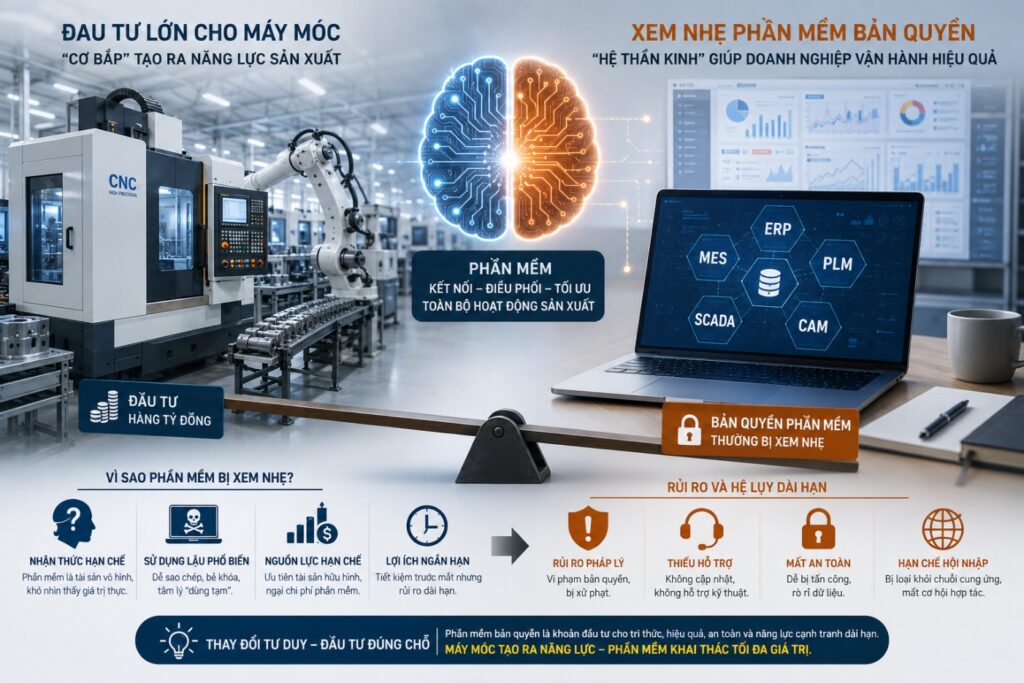
In reality, countless modern pieces of equipment cannot unleash their full potential without the corresponding supporting software. For example, a CNC machining center costing billions of VND will have its capabilities severely limited without standard CAM software to program and optimize toolpaths.
Similarly, on the digital transformation journey, systems like ERP, MES, SCADA, PLM, or data analytics tools act as the “brain” coordinating the production pace, linking information across departments, and helping leadership make decisions.
If machinery is considered the “muscle” that generates machining capacity, then software is exactly the “nervous system” that ensures the entire system operates smoothly and efficiently.
Why do businesses still ignore software licenses?
1. Consumption Mindset
Software is an intangible asset, and many people still mistakenly believe that purchasing a license is merely buying a “certificate” or an activation “key.” Most have not seen the core value embedded in the knowledge content, core technology, algorithms, patches, expert support services, and especially the legal right to use it.
Because it cannot be physically interacted with like a machinery line, the actual value of software is often severely underestimated.
2. Habits
Unlike hardware equipment, which is almost impossible to “pirate,” software is easily cracked, copied, or installed illegally at an extremely low cost. This loophole breeds mentalities like “just use it temporarily,” “buy it later,” or “deal with it when there is an inspection,” causing budget disbursements for licenses to be continuously delayed.
This category is always pushed down below tangible equipment investments, despite its irreplaceable role in the manufacturing process.
3. Resources
Another commonly cited reason is that small-scale businesses with tight finances cannot yet invest in licensed software for fear of driving up costs and reducing competitiveness. However, this argument is only valid within a short-term mindset and a narrow scope.
Once a business has sufficient budget to equip modern machinery, they also need to recognize that software is an inseparable component of that investment. The software purchasing fee is not an incurred cost, but a necessary expense to maximize the value of the acquired assets. An advanced production line operated by incompatible or unlicensed software will fail to achieve optimal performance, and may even drag down the efficiency of an entire expensive machinery system.
If there is any advantage to using unlicensed software, it is merely an immediate benefit. In exchange for the saved budget, the business has to bear countless long-term risks:
-
Systems not being updated with new versions.
-
Losing technical support from the provider.
-
Facing the risk of information security breaches.
-
Production stagnation, or most seriously, the risk of violating Intellectual Property Laws.
More importantly, using illegal software might not cause much trouble if the business only operates on a small, domestic scale. However, when you want to scale up, participate in the global supply chain, or partner with multinational corporations, this becomes a significant barrier. International partners always have a very strict supplier audit process, in which legal compliance, including the use of licensed software, is a core criterion. A business using pirated software can easily be disqualified right from the initial evaluation round, regardless of how excellent their machining capabilities are.
Investing in licensed software is therefore not merely a matter of legal compliance; it also reflects the organization’s management capacity, professionalism, and readiness for integration. In the context of deepening digital transformation and globalization, software licenses need to be recognized as a crucial technological asset, equal in value to factories or equipment.
The paradox in technology investment will only be resolved when businesses change their perspective: licensed software is not the cost of buying a “key,” but an investment in a knowledge foundation, operational capacity, security, and long-term competitiveness. Machinery creates production capacity, but it is the software that dictates what percentage of that capacity’s value the business can truly exploit.
Contact Vietbay for direct consultation on suitable genuine software licenses