
Phần mềm CAD 2D đóng vai trò vô cùng quan trọng trong quy trình làm việc của m
2D CAD software plays a crucial role in the workflow of every design engineer. However, finding a truly reliable platform among hundreds of solutions on the market is always a major challenge. Investing in the right tool not only helps accelerate project timelines but also optimizes resources for the business.
The article below will provide you with a comprehensive perspective on the differences between 2D and 3D CAD, as well as the evaluation criteria to choose the most suitable solution in terms of features, speed, and cost.
1. What is 2D CAD Software?
2D CAD (Computer-Aided Design) is a specialized tool used to create technical drawings on a two-dimensional plane. This solution is widely applied in the engineering, architecture, and construction industries.
CAD software focuses on creating technical documents with absolute precision, such as floor plans, schematics, or blueprints, helping to translate ideas into the clearest and most visual technical specifications.
2. Differentiating 2D CAD vs 3D CAD
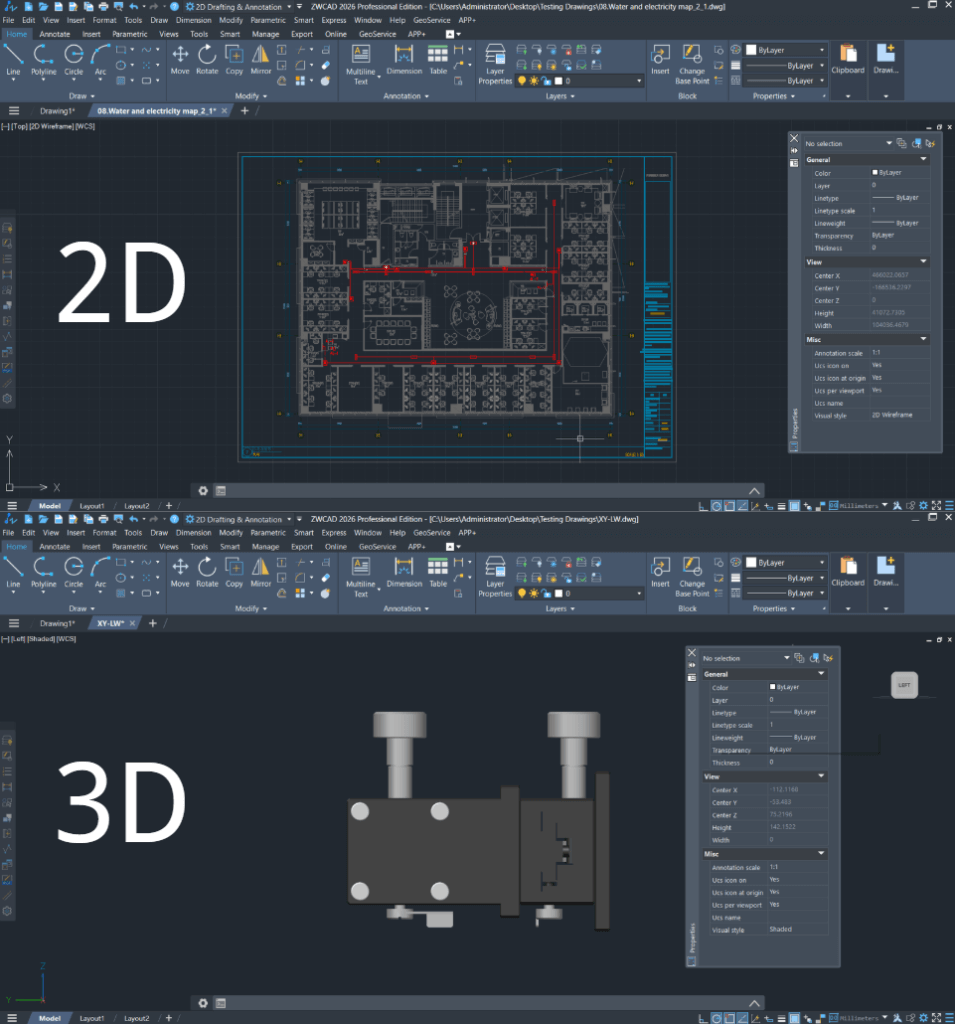
2.1. Display Space
While 2D drawings limit the representation of objects to a coordinate plane, 3D modeling integrates spatial depth, providing a multidimensional and more intuitive view of the object.
2.2. Cost and Hardware Requirements
2D CAD systems generally have lower investment costs and can operate smoothly on standard-configuration computers.
Conversely, 3D CAD requires a larger budget for software licensing and powerful hardware systems to process massive graphical workloads.
2.3. Detail and Accuracy Levels
2D drawings are highly effective for accurately annotating dimensions, tolerances, machining details, and structural elements. Therefore, 2D CAD is suitable for design documentation and 2D technical drafting.
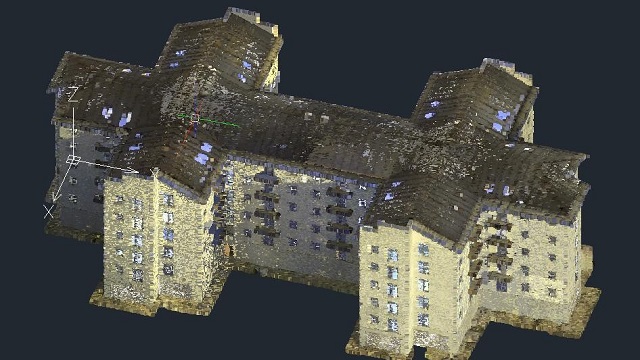
3D CAD, on the other hand, is better suited for evaluating overall design schemes, clash detection, or presenting ideas to clients.
3. Core Criteria for Choosing 2D CAD Software
3.1. Identifying Needs by Industry
Each industry requires distinct technical standards. Architectural and mechanical companies will need toolsets with industry-standard precision tolerances.
Conversely, beginners or individual professionals only need basic drafting tools without an excess of complex features.
3.2. User-Friendliness
Good software must come with an intuitive user experience. Platforms with familiar, easy-to-navigate interfaces will help new engineers get up to speed quickly, minimizing internal training time compared to overly complex tools.
3.3. Cost
Although premium solutions possess a diverse feature set, their prices are very high. Businesses need to strike a balance to choose a tool that fits their budget while still fully meeting operational demands. Individuals or small businesses should avoid using free software that lacks advanced features.
4. ZWCAD – A Comprehensive 2D CAD Design Solution for Businesse
4.1. Functionality
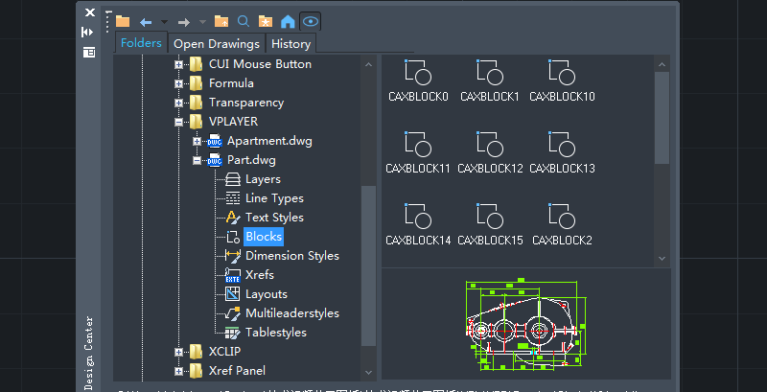
Going far beyond standard Annotation or Dimensioning tools, ZWCAD integrates a series of advanced technologies such as Parametric Design, Similar Part Search, and Smart Match. These features help automate the layout process and enhance drawing accuracy.
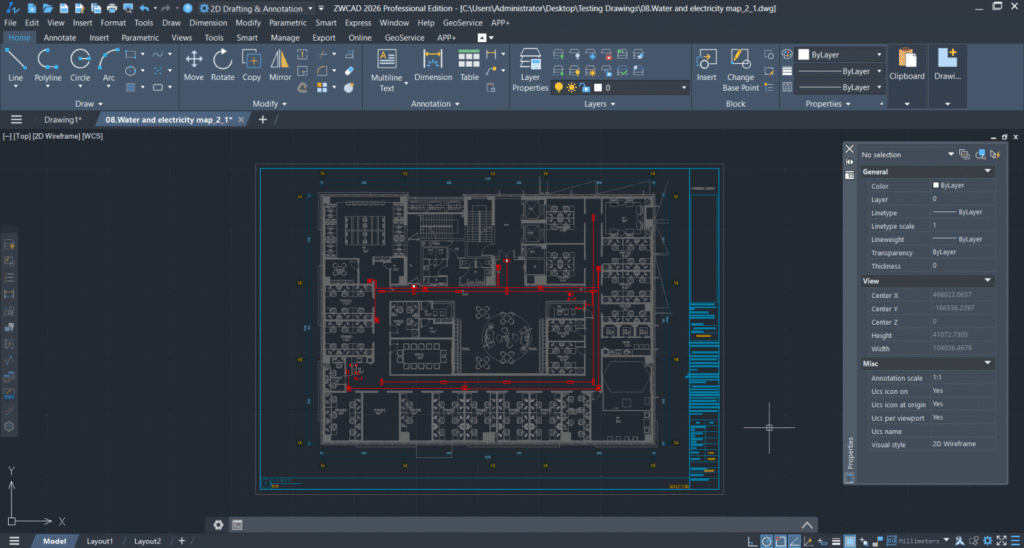
Simultaneously, with a diverse ecosystem of third-party Add-ons, users can easily install additional specialized utilities.
Notably, the software interface is designed to be highly familiar, enabling new engineers to operate it effectively right from their first use.
4.2. Compatibility
ZWCAD completely resolves data communication barriers by smoothly supporting the import/export of popular formats like DWG, DXF, and DWT, along with file standards such as STEP, IFC, PDF, PNG, and JPG.
Exchanging drawings with partners using AutoCAD will be seamless without worrying about formatting errors.
4.3. Customization
Businesses can entirely build their own automation commands according to internal processes thanks to ZWCAD’s extensive API system (supporting .NET, VBA, LISP, and ZRX).
Customizing the user interface (UI) is also easily accomplished to maintain old working habits.
4.4. Performance
When working with large-capacity and structurally complex 2D drawings, the ZWCAD platform demonstrates outstanding power with processing speeds 1.98 times faster than AutoCAD.
This translates to shortening the project completion cycle and boosting productivity for engineers.
4.5. Cost
Instead of annual subscription fee models, ZWCAD offers a perpetual licensing policy (one-time purchase, lifetime use). This helps organizations optimize their software investment costs, eliminating the burden of paying expensive annual subscription fees.
Conclusion
Deciding to invest in a 2D CAD software requires a thorough analysis of the project nature, budget, and technical requirements.
Possessing powerful operational capabilities, effective compatibility, excellent processing performance, and a cost-optimizing licensing model, ZWCAD truly deserves to be a reliable and professional 2D CAD tool for today’s engineering businesses.
Contact Vietbay today to get direct consultation from our expert team on solutions tailored to your business needs