
In semiconductor development, pre-silicon verification is a critical step in identifying design errors and evaluating system functionality before chip fabrication. However, as SoC designs become increasingly complex, verification must deliver not only accuracy but also sufficient execution speed to run firmware, operating systems, and real-world software applications.
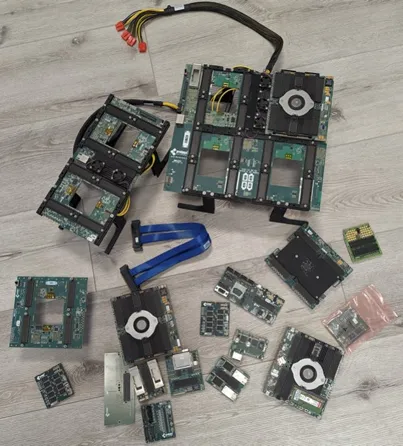
FPGA Prototyping addresses this requirement by implementing chip designs on FPGA hardware. With operating speeds reaching tens of MHz, this approach can reduce testing time from several days to just a few minutes for suitable workloads.
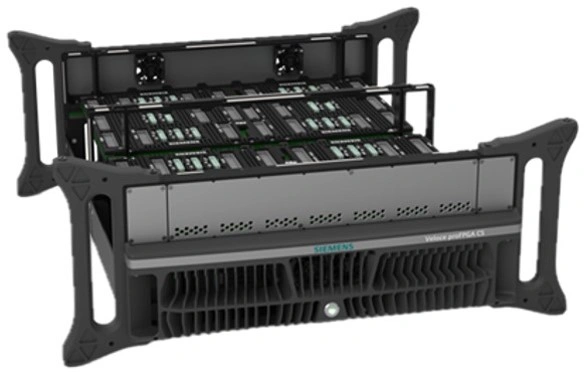
As technology advances, FPGA Prototyping systems have also evolved from manually configured setups into specialized platforms that integrate hardware and software to simplify deployment. Among these solutions, Siemens Veloce proFPGA CS, combined with Veloce Prototyping Software (VPS), provides a platform for SoC verification and system validation before chip fabrication.
1. Architecture of an FPGA Prototyping System
A modern FPGA Prototyping platform combines three key components to transform RTL designs into operational hardware systems that can be tested:
- FPGA Hardware: Uses one or more FPGAs to implement SoC or IP designs. For large-scale designs, the system can distribute the design across multiple FPGAs to meet hardware resource requirements.
- Design Compilation and Mapping Software: Takes ASIC RTL code, processes the conversion, and maps the design onto the FPGA system. This component is essential for handling large-scale designs, particularly when functionality must be partitioned across multiple FPGAs.
-
Test Environment: Provides input signals and connections to real-world system interfaces such as sensors, cameras, and Ethernet traffic. This allows designs to be tested under conditions that closely resemble actual operating environments.
When these three components work together, the system creates a cycle-accurate Digital Twin of the SoC or IP design. The platform operates at a speed sufficient to boot firmware, run operating systems, and execute real-world software applications.
This is a key distinction between FPGA Prototyping and simulation methods with lower execution speeds: engineers can test designs in conditions that more closely reflect actual system operation.
2. Siemens Veloce proFPGA CS and VPS Software
To implement FPGA Prototyping effectively, a system needs more than hardware capabilities. It also requires tools to support design conversion, partitioning, and debugging. Siemens provides the Veloce proFPGA CS platform in combination with Veloce Prototyping Software (VPS) to address these requirements.
Veloce proFPGA CS provides the hardware platform for implementing designs on FPGAs, while also supporting debugging capabilities through Memory Backdoor Access.
With this capability, engineers can:
- Update Boot Images.
- Monitor register contents.
- Access and inspect memory contents.
- Connect the system to real-world interfaces for testing.
These capabilities help engineers monitor system status and verify designs throughout the prototyping process.
Alongside the hardware platform, Siemens developed Veloce Prototyping Software (VPS) to support the technical processes involved in deploying RTL designs across multi-FPGA systems. Its key functions include:
- Automated RTL Transformation: Converts RTL designs to make them compatible with the FPGA architecture.
- Automated Design Partitioning: Distributes the design across multiple FPGAs and inserts Pin Multiplexing.
- Timing-Based Performance Optimization: Supports optimization based on Timing requirements to reduce software execution time.
- Integrated Debug: Incorporates debugging capabilities into the Prototyping environment to support design verification and error resolution.
The combination of Veloce proFPGA CS and VPS addresses both key aspects of FPGA Prototyping: implementing designs on hardware and providing engineering support throughout system configuration and verification.
As SoC designs grow in scale and software workloads become increasingly demanding, FPGA Prototyping is becoming an essential tool for validating designs before chip fabrication. However, the effectiveness of this approach depends significantly on the ability to implement designs, manage configurations, and debug the system.
Learn more:
- Siemens Veloce proFPGA CS: Accelerating FPGA Prototyping Deployment
- Veloce: A Hardware-Assisted Verification Platform for Accelerating Chip Development
- Siemens EDA and Vietbay Support Leading Semiconductor Companies at SEMIEXPO Vietnam 2026
Contact Vietbay for direct consultations: