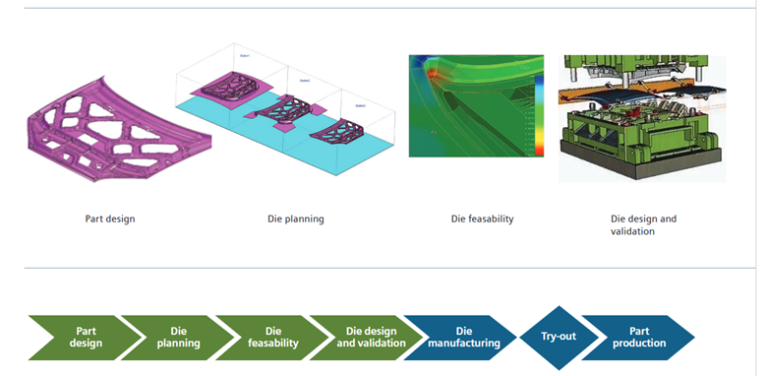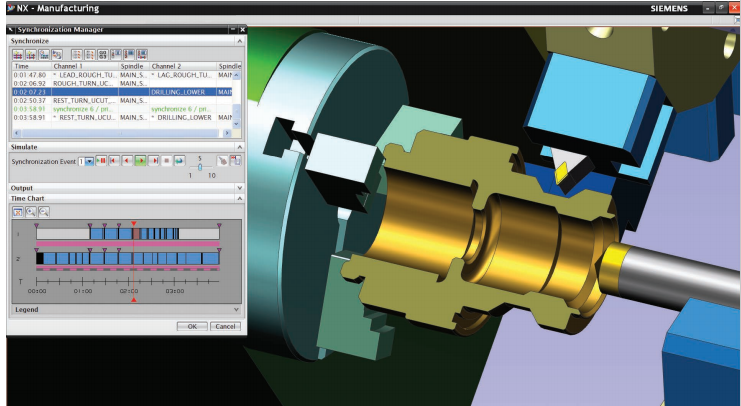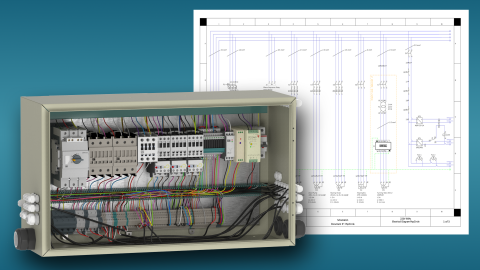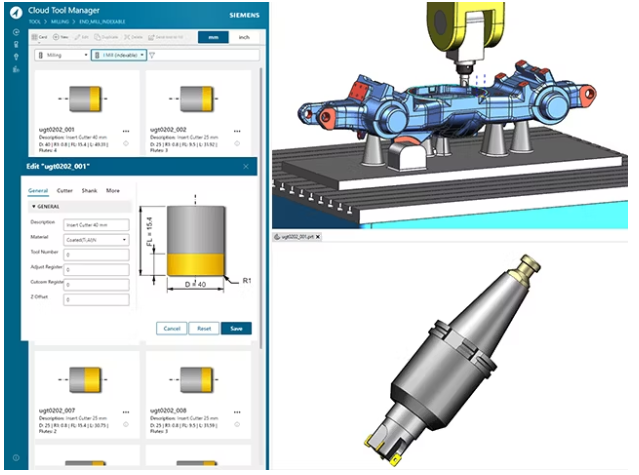

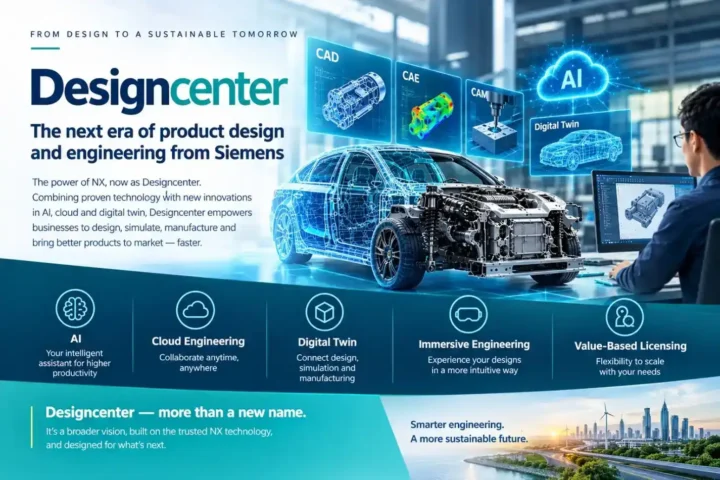
As the manufacturing industry undergoes rapid transformation driven by Artificial Intelligence (AI), cloud computing, and Digital Twin technology, Siemens continues to advance its engineering portfolio with Designcenter – a next-generation product design and engineering portfolio built on the proven technology of NX.
The transition from NX to Designcenter is more than a change in product branding. It reflects Siemens’ broader strategic direction to connect engineering disciplines, expand access to advanced technologies, and create a more integrated environment for product development—from initial concept through simulation and manufacturing.
1. Designcenter – Building on the Strength of NX, Expanding the Future of Engineering
NX has long been recognized as a leading CAD/CAM/CAE solution, supporting the development of complex products across industries such as precision engineering, automotive, aerospace, electronics, industrial equipment, and mold manufacturing.
In January 2025, Siemens introduced the Designcenter NX brand as part of its broader Designcenter portfolio. In June 2026, Siemens officially renamed Designcenter NX to Designcenter, reflecting a unified product naming approach across its on-premises and SaaS offerings.
This does not mean that customers must move to an entirely different software platform. Designcenter continues to build on NX technology, capabilities, and established engineering workflows while representing Siemens’ broader vision for modern product engineering.
Designcenter supports businesses across several interconnected engineering disciplines:
- CAD – Computer-Aided Design: Develop 3D models, detailed components, assemblies, and engineering drawings.
- CAM – Computer-Aided Manufacturing: Support CNC programming, optimize machining processes, and connect product design with manufacturing.
- CAE – Computer-Aided Engineering: Evaluate product performance, validate designs, and identify potential issues before physical production.
- Digital Twin: Connect engineering data and processes to build a more comprehensive digital representation of products throughout their lifecycle.
- Collaborative Engineering: Improve coordination among design, simulation, manufacturing, and other engineering teams.
Together, these capabilities help businesses move beyond isolated design activities toward a more integrated, consistent, and efficient product development environment.
 2. Why Is Siemens Transitioning from NX to Designcenter?
Siemens’ rebranding strategy is closely aligned with its ambition to deliver a more unified engineering portfolio rather than positioning each software application as an independent tool.
A Unified Engineering Ecosystem
Designcenter sits within the broader Siemens Xcelerator ecosystem, alongside solutions such as Teamcenter, Simcenter, and Opcenter.
This approach emphasizes the connection between product design, lifecycle data management, engineering simulation, manufacturing planning, and production operations.
Expanding Beyond CAD into Comprehensive Product Engineering
The Designcenter brand reflects a broader scope of engineering capabilities and closer integration of CAD/CAM/CAE with other product development processes.
The goal is not simply to create a 3D model, but to help businesses design, validate, optimize, and bring products to market more efficiently.
Making Advanced Technologies More Accessible
Siemens continues to develop tools that help engineers, designers, manufacturing specialists, and other stakeholders access and work with engineering data more effectively.
Cloud-based collaboration, AI assistance, and immersive engineering technologies are expanding the ways engineering teams can work together.
Flexible Deployment and Scalable Capabilities
The Designcenter portfolio includes on-premises solutions and Designcenter X SaaS offerings. Businesses can select an approach that fits their IT infrastructure, data management requirements, project scale, and digital transformation strategy.
Ultimately, Designcenter is more than a new name. It reflects Siemens’ commitment to a connected, flexible engineering environment that is ready for the next generation of product development technologies.
3. Key Technologies Shaping the Future of Designcenter
Artificial Intelligence – An Intelligent Assistant for Engineers
AI is creating new opportunities in product design and development. Siemens has introduced Design Copilot NX, an AI assistant designed to help users find information, understand software capabilities, and access technical guidance using natural language.
Instead of spending excessive time searching documentation or memorizing every software command, engineers can ask questions and obtain guidance to help address challenges during their work.
Siemens’ broader AI direction also aims to support workflow automation, improve productivity, and allow engineers to focus more on high-value design decisions.
Specific AI capabilities depend on the software release, configuration, and licensed package.
Digital Twin – Connecting Design, Simulation, and Manufacturing
Digital Twin technology is a key pillar of Siemens’ digital transformation strategy. By connecting design data with simulation, manufacturing, and product lifecycle management tools, businesses can evaluate engineering alternatives earlier in the development process.
This approach helps identify potential issues involving structural performance, manufacturability, and product behavior. It can reduce the need for physical prototypes, minimize late-stage design changes, and improve engineering decision-making.
Designcenter plays an important role in creating accurate engineering data that can serve as a foundation for developing Digital Twins throughout the product lifecycle.
Cloud Engineering – Collaborative Product Development in the Cloud
With Designcenter X, Siemens extends access to engineering technology through a Software-as-a-Service (SaaS) model. Depending on the selected offering, capabilities may include core design tools, integrated data management, supported browser-based access, online collaboration, and design sharing.
This model can help businesses reduce software infrastructure administration, simplify deployment and updates, and enable geographically distributed engineering teams to work together more effectively.
For organizations that are not ready to move their entire engineering environment to the cloud, Siemens continues to offer on-premises Designcenter solutions, allowing businesses to choose an approach that meets their operational and IT policies.
Immersive Engineering – A More Intuitive Design Experience
Immersive engineering expands the ways engineering teams visualize and evaluate products. Rather than reviewing models exclusively on a conventional computer screen, users can explore designs in more interactive environments through supported virtual reality and mixed reality technologies.
These capabilities can support the evaluation of product form, layout, accessibility, and assembly-related considerations while improving communication between design, manufacturing, and other stakeholders.
Value-Based Licensing – Scaling Capabilities to Business Needs
In addition to technology innovation, Siemens provides flexible licensing approaches, including Value-Based Licensing for supported solutions and packages.
Token-based licensing can allow businesses to access selected advanced capabilities according to their needs, rather than purchasing a separate license for every specialized function in every situation.
This approach can help organizations balance engineering capabilities, usage patterns, and software investment.
The appropriate licensing model depends on the applicable terms, supported modules, and actual usage requirements.
4. How Can Designcenter Benefit Manufacturing Businesses?
In an increasingly competitive environment, businesses need more than powerful design tools. They need efficient, adaptable, and scalable product development processes.
Designcenter can help organizations pursue several practical business objectives:
- Shorten product development cycles: Improve connections between design, validation, and manufacturing while reducing unnecessary data transfers.
- Improve design quality: Identify engineering issues earlier, evaluate alternatives, and reduce development risks.
- Optimize machining processes: Connect product design with CAM programming and manufacturing preparation.
- Strengthen collaboration: Improve engineering data exchange and coordination among departments, partners, and technical teams.
- Enable AI and Digital Twin adoption: Establish a consistent engineering data foundation for future digital transformation initiatives.
- Maintain investment flexibility: Select deployment options and solution configurations that align with operational requirements, security policies, and budgets.
These benefits are particularly relevant to precision engineering, automotive and component manufacturing, aerospace, electronics, mold and die manufacturing, and other industries with demanding engineering requirements.
5. Vietbay – Your Partner in Adopting Siemens Designcenter Technology
As a technology solutions provider serving businesses in Vietnam, Vietbay Technology Co., Ltd. aims to help customers access and effectively leverage Siemens solutions for design, simulation, and manufacturing. We understand that digital transformation is not simply about investing in software. It requires selecting the right technologies, improving engineering workflows, and strengthening the capabilities of technical teams.
Vietbay can support businesses in exploring and selecting suitable solutions, assessing application requirements, advising on configurations and deployment approaches, and providing technical support and training within the agreed service scope.
From 3D design and assembly modeling to CNC machining programming and the integration of engineering data with simulation and manufacturing processes, our objective is to help customers realize greater value from technology throughout product development.
Learn more
- Free Designcenter Student Edition: How to Download, Install, and Update
- Designcenter 2606: Discover the Latest Features
- Designcenter 2606 Mold Wizard: Improve Mold Design with the Latest Updates
Meet Vietbay’s team of experts at SEMIEXPO Vietnam 2026 to discuss Siemens EDA solutions and explore emerging trends in semiconductor design technology.
📅 Date: December 3–4, 2026
📍 Venue: Thiskyhall Sala Convention Center, Ho Chi Minh City👉 Register here
About Us
Vietbay – Siemens’ official distributor in Vietnam – provides software solutions and digital engineering services, including consulting, implementation, and after-sales technical support.